




 1-800-419-1152
 Contact
 Andy's Parts Smarts
 Cart
Cart
Hello, Sign In!

Select Your Vehicle
Select Your Vehicle
Bully Dog BD Watchdog Programmer - Big Rig Heavy Duty GT WatchDog


Part #: 46501

$449.00 For each

Featured Videos
-
Video Description:In this video, we tell you about the gauges that we installed in our project Integra. Highlights include:
*At 0:59, we talk about the specific gauges we chose and why.
*At 1:46, we talk about gauge accessories, such as sandwich adapters for oil lines.
*At 2:36, we begin our gauges installation.
*At 3:25, we install some gauges in our GlowShift gauge bezel.
*At 6:12, we show you how we installed our boost vacuum gauge's sending unit under the hood.
*At 7:12, we install our oil filter sandwich adapter so that we can get an accurate oil pressure and temperature reading.
*At 10:10, we install our water temperature sending unit.
*At 15:20, we show you the results of our efforts - a slew of new performance gauges! -
Video Description:In this video, we go over the ins and outs of aftermarket gauges. Highlights include:
*At 0:38, we explain why aftermarket gauges are usually more accurate, and therefore more useful, than factory gauges.
*At 0:48, we talk about air/fuel ratio gauges.
*At 2:14, we talk about boost gauges.
*At 2:30, we tell you about boost vacuum gauges.
*At 2:42, we go over fuel pressure gauges.
*At 2:56, we talk about oil pressure gauges.
*At 3:07, we talkabout oil temperature gauges.
*At 3:28, we tell you about water temperature gauges.
*At 3:40, we talk about tachometers.
*At 4:02, we talk about voltmeters and amp gauges.
*At 4:28, we go over exhaust gas temperature gauges.
*At 4:44, we offer our opinion of the most critical gauges to get for your vehicle.
*At 5:08, we tell you about the different types, styles and sizes of gauges available, including mechanical, electric, analog, and digital. -
Video Description:In this video, we show you a typical installation of aftermarket gauges into a diesel truck. Highlights include:
*At 0:36, we tell you which gauges we chose for our installation, and why.
*At 2:22, we get started with the installation of our gauges, beginning with our exhaust gas temperature gauge sending unit.
*At 3:53, we begin the installation of our transmission temperature gauge sending unit.
*At 4:55, we install our boost gauge sending unit
*At 6:50, we run our sending unit wires inside the cab of the truck so that we can hook up our gauges.
*At 8:50, we show you how to tie your gauge wiring into your fuse block.
At 12:45, we install our GlowShift gauge pod.
*At 14:00, we finally hook up the gauges themselves.
*At 14:42, we turn on our new gauges for the first time! -
Video Description:So why do you need a transmission temperature gauge? Watch this video to find out! Highlights include:
*At 0:15, we explain the different situations in which you may need a trans temp gauge.
Fits On:
Universal
Description:
Bully Dog Big Rig Heavy Duty GT WatchDog
Bully Dog Big Rig Heavy Duty GT WatchDog
Bully Dog was formed in 1998 in Aberdeen, Idaho. The founders of Bully Dog – Michael, Phillip, and Daryl Klassen were heavily influenced by their father Harold’s interest in improving vehicle performance. Several years prior to the company’s inception, Harold had experimented with increasing performance on his diesel farm tractor by injecting propane into the engine’s combustion chamber.
In 1998, Bully Dog’s owners took this concept and developed and patented a safe and effective propane injection system to enhance diesel engine performance. These systems were first sold out of their farm shop, but as demand increased, the owners moved their company to another location and officially organized Bully Dog.
Bully Dog’s quest was now to be recognized as the leader in the diesel performance industry, which motivated them to stay abreast of new technology in this industry. With the introduction of electronic components and software to improve performance, they began to research new types of products like intake and exhaust systems to complement their electronic components. Bully Dog was now able to offer a complete performance package.
In 2005, the company expanded its range of products to include performance products for gasoline powered vehicles.
Bully Dog products are built to be flexible, allowing each user to get their own desired result, from outrageous performance on the race track to improved fuel economy driving down the highway.
Each product goes through an in-depth research and development (R&D) followed by a grueling development procedure that is carried out by a staff of the best engineers in the world. Once designed, each product is put through months of real world testing, this testing is performed across the United States so that Bully Dog can be sure that each product works correctly and flawlessly in various elevations, weather conditions and driving situations from towing a heavy load to racing down the track.
Bully Dog products have been featured in countless media venues, including a Dodge Ram build-up covered by Trucks! on the Speed Channel. That truck also featured the exclusive Andy's Auto Sport Dodge Ram Blaze body kit. The end results was a beast of a truck!
In 1998, Bully Dog’s owners took this concept and developed and patented a safe and effective propane injection system to enhance diesel engine performance. These systems were first sold out of their farm shop, but as demand increased, the owners moved their company to another location and officially organized Bully Dog.
Bully Dog’s quest was now to be recognized as the leader in the diesel performance industry, which motivated them to stay abreast of new technology in this industry. With the introduction of electronic components and software to improve performance, they began to research new types of products like intake and exhaust systems to complement their electronic components. Bully Dog was now able to offer a complete performance package.
In 2005, the company expanded its range of products to include performance products for gasoline powered vehicles.
Bully Dog products are built to be flexible, allowing each user to get their own desired result, from outrageous performance on the race track to improved fuel economy driving down the highway.
Each product goes through an in-depth research and development (R&D) followed by a grueling development procedure that is carried out by a staff of the best engineers in the world. Once designed, each product is put through months of real world testing, this testing is performed across the United States so that Bully Dog can be sure that each product works correctly and flawlessly in various elevations, weather conditions and driving situations from towing a heavy load to racing down the track.
Bully Dog products have been featured in countless media venues, including a Dodge Ram build-up covered by Trucks! on the Speed Channel. That truck also featured the exclusive Andy's Auto Sport Dodge Ram Blaze body kit. The end results was a beast of a truck!
Featured Videos
-
Video Description:In this video, we tell you about the gauges that we installed in our project Integra. Highlights include:
*At 0:59, we talk about the specific gauges we chose and why.
*At 1:46, we talk about gauge accessories, such as sandwich adapters for oil lines.
*At 2:36, we begin our gauges installation.
*At 3:25, we install some gauges in our GlowShift gauge bezel.
*At 6:12, we show you how we installed our boost vacuum gauge's sending unit under the hood.
*At 7:12, we install our oil filter sandwich adapter so that we can get an accurate oil pressure and temperature reading.
*At 10:10, we install our water temperature sending unit.
*At 15:20, we show you the results of our efforts - a slew of new performance gauges! -
Video Description:In this video, we go over the ins and outs of aftermarket gauges. Highlights include:
*At 0:38, we explain why aftermarket gauges are usually more accurate, and therefore more useful, than factory gauges.
*At 0:48, we talk about air/fuel ratio gauges.
*At 2:14, we talk about boost gauges.
*At 2:30, we tell you about boost vacuum gauges.
*At 2:42, we go over fuel pressure gauges.
*At 2:56, we talk about oil pressure gauges.
*At 3:07, we talkabout oil temperature gauges.
*At 3:28, we tell you about water temperature gauges.
*At 3:40, we talk about tachometers.
*At 4:02, we talk about voltmeters and amp gauges.
*At 4:28, we go over exhaust gas temperature gauges.
*At 4:44, we offer our opinion of the most critical gauges to get for your vehicle.
*At 5:08, we tell you about the different types, styles and sizes of gauges available, including mechanical, electric, analog, and digital. -
Video Description:In this video, we show you a typical installation of aftermarket gauges into a diesel truck. Highlights include:
*At 0:36, we tell you which gauges we chose for our installation, and why.
*At 2:22, we get started with the installation of our gauges, beginning with our exhaust gas temperature gauge sending unit.
*At 3:53, we begin the installation of our transmission temperature gauge sending unit.
*At 4:55, we install our boost gauge sending unit
*At 6:50, we run our sending unit wires inside the cab of the truck so that we can hook up our gauges.
*At 8:50, we show you how to tie your gauge wiring into your fuse block.
At 12:45, we install our GlowShift gauge pod.
*At 14:00, we finally hook up the gauges themselves.
*At 14:42, we turn on our new gauges for the first time! -
Video Description:So why do you need a transmission temperature gauge? Watch this video to find out! Highlights include:
*At 0:15, we explain the different situations in which you may need a trans temp gauge.
Q: How do I install a tach in a car that did not come with one? How difficult is it?
A: A tachometer is a great instrument to have in your car. Monitoring your engines RPM will help you shift at the appropriate time to gain the best performance or even better gas mileage. Most aftermarket tachometers only have 3 or 4 wires that need to be connected for operation. A main power wire that gets connected to a 12 volt ignition source, a ground wire, a tach signal wire that connects to the coil or the designated signal wire in your cars wiring diagram, and sometimes a wire to run the light inside the tach for night time use, which can be connected to the same power source as your other dash lights. If your car did not come with a tach, but it was an option for your specific model then there is a good chance the wiring is already in place to run the tachometer. It is best to purchase a factory service manual and carefully study the wiring schematics to determine if the wiring is there or not. The only tools you will need for this wiring job are a pair of wire cutters, a pair of wire strippers, a good pair of wire crimpers, some crimp-on style electrical connectors and a little electrical tape. While this is a pretty simple job, if you are not comfortable using these tools it is best to seek professional help.
If you are trying to install a late model gauge cluster, including a tach, into an older model car that did not have one the process is a little more complicated. You will need the wiring diagrams for both the donor vehicle and the car you are installing the gauge cluster in. You will then have to carefully trace and mark each wire to determine what it is for. Finally you connect the appropriate wires together (temp gauge to temp sender wire etc.) and carefully tape off any wires that are unused. Because modern cars use have varied computer controlled components it is not always possible or compatible to swap gauge clusters so it is important to research the subject for your specific model before taking the plunge.
Q: How do you install gauges?
A: Some gauges are electrical while some are mechanical. Electrical gauges use sensors that have to be installed, while mechanical gauges rely on hoses for feedback. All gauges must be wired up for lighting within your vehicle.
Q: Do gauges work on any vehicle?
A: Gauges are universal and can be mounted virtually anywhere in any vehicle. Gauge pods are usually used to house these aftermarket gauges within your vehicle.
Q: What are the different types of gauges available?
A: There are dozens of gauges available which monitor all types of engine performance. Some common ones are air/fuel ratio, oil pressure, oil temperature, coolant temperature, exhaust temperature, fuel pressure and nitrous pressure gauges. Several more are available, so check our product pages to get more details.
Q: Why buy gauges?
A: Gauges can give you the warm feeling of knowing that your engine is healthy and warn you when it isn't. The main gauges that help you monitor the health of any high-performance engine would be the basic gauges, such oil pressure, oil temperature and coolant temperature. Aside from that, they give your car that custom race look.
A: A tachometer is a great instrument to have in your car. Monitoring your engines RPM will help you shift at the appropriate time to gain the best performance or even better gas mileage. Most aftermarket tachometers only have 3 or 4 wires that need to be connected for operation. A main power wire that gets connected to a 12 volt ignition source, a ground wire, a tach signal wire that connects to the coil or the designated signal wire in your cars wiring diagram, and sometimes a wire to run the light inside the tach for night time use, which can be connected to the same power source as your other dash lights. If your car did not come with a tach, but it was an option for your specific model then there is a good chance the wiring is already in place to run the tachometer. It is best to purchase a factory service manual and carefully study the wiring schematics to determine if the wiring is there or not. The only tools you will need for this wiring job are a pair of wire cutters, a pair of wire strippers, a good pair of wire crimpers, some crimp-on style electrical connectors and a little electrical tape. While this is a pretty simple job, if you are not comfortable using these tools it is best to seek professional help.
If you are trying to install a late model gauge cluster, including a tach, into an older model car that did not have one the process is a little more complicated. You will need the wiring diagrams for both the donor vehicle and the car you are installing the gauge cluster in. You will then have to carefully trace and mark each wire to determine what it is for. Finally you connect the appropriate wires together (temp gauge to temp sender wire etc.) and carefully tape off any wires that are unused. Because modern cars use have varied computer controlled components it is not always possible or compatible to swap gauge clusters so it is important to research the subject for your specific model before taking the plunge.
Q: How do you install gauges?
A: Some gauges are electrical while some are mechanical. Electrical gauges use sensors that have to be installed, while mechanical gauges rely on hoses for feedback. All gauges must be wired up for lighting within your vehicle.
Q: Do gauges work on any vehicle?
A: Gauges are universal and can be mounted virtually anywhere in any vehicle. Gauge pods are usually used to house these aftermarket gauges within your vehicle.
Q: What are the different types of gauges available?
A: There are dozens of gauges available which monitor all types of engine performance. Some common ones are air/fuel ratio, oil pressure, oil temperature, coolant temperature, exhaust temperature, fuel pressure and nitrous pressure gauges. Several more are available, so check our product pages to get more details.
Q: Why buy gauges?
A: Gauges can give you the warm feeling of knowing that your engine is healthy and warn you when it isn't. The main gauges that help you monitor the health of any high-performance engine would be the basic gauges, such oil pressure, oil temperature and coolant temperature. Aside from that, they give your car that custom race look.
If you live in California, please note this item may be subject to a Proposition 65 warning. Click here to learn more.

When you click on links to various merchants on this site and make a purchase, this can result in this site earning a commission. Affiliate programs and affiliations include, but are not limited to, the eBay Partner Network.
Not able to find what you are looking for?

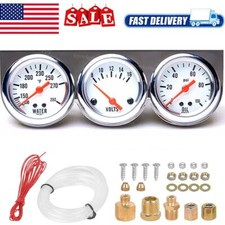
3-in-1 2" 52mm Chrome Car Triple Gauge Set Water Temp Oil Pressure Volt Meter

Mini Triple Gauge Kit Black /Black Beze Sunpro 1 1/2" l New CP8094 Warranty

Intellitronix DP10001G Universal 5 Gauge Digital Dash Panel GREEN LEDs USA Made
Core Fee

2007-2008 Z71 Tahoe Suburban Yukon Avalanche Gauge Cluster



© 1997- Andy's Auto Sport | All Rights Reserved.